< ISS024-E-14233 >
| NASA Photo ID | ISS024-E-14233 |
| Focal Length | 50mm |
| Date taken | 2010.09.11 |
| Time taken | 11:24:10 GMT |
Resolutions offered for this image:
1000 x 665 pixels 540 x 359 pixels 720 x 480 pixels 1500 x 1029 pixels 640 x 439 pixels
1000 x 665 pixels 540 x 359 pixels 720 x 480 pixels 1500 x 1029 pixels 640 x 439 pixels


Spacecraft nadir point: 49.6° N, 55.4° E
Photo center point: 45.5° N, 48.5° E
Photo center point by machine learning:
Photo center point: 45.5° N, 48.5° E
Photo center point by machine learning:
Nadir to Photo Center: Southwest
Spacecraft Altitude: 187 nautical miles (346km)
Country or Geographic Name: | RUSSIAN FEDERATION |
Features: | CASPIAN SEA, VOLGA RIVER DELTA, URAL RIVER DELTA, SMOKE PLUME, SUNGLINT |
| Features Found Using Machine Learning: | PAN- |
Cloud Cover Percentage: | 25 (11-25)% |
Sun Elevation Angle: | 30° |
Sun Azimuth: | 238° |
Camera: | Nikon D3X Electronic Still Camera |
Focal Length: | 50mm |
Camera Tilt: | High Oblique |
Format: | 6048E: 6048 x 4032 pixel CMOS sensor, 35.9mm x 24.0mm, total pixels: 25.72 million, Nikon FX format |
Film Exposure: | |
| Additional Information | |
| Width | Height | Annotated | Cropped | Purpose | Links |
|---|---|---|---|---|---|
| 1000 pixels | 665 pixels | No | Yes | Earth From Space collection | Download Image |
| 540 pixels | 359 pixels | Yes | Yes | Earth From Space collection | Download Image |
| 720 pixels | 480 pixels | Yes | Yes | NASA's Earth Observatory web site | Download Image |
| 1500 pixels | 1029 pixels | No | No | Download Image | |
| 640 pixels | 439 pixels | No | No | Download Image |
Download Packaged File
Download a Google Earth KML for this Image
View photo footprint information
No GeoTIFF is available for this photo.Image Caption:
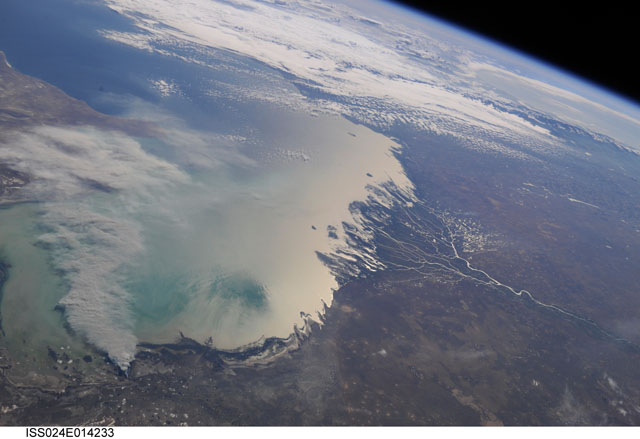
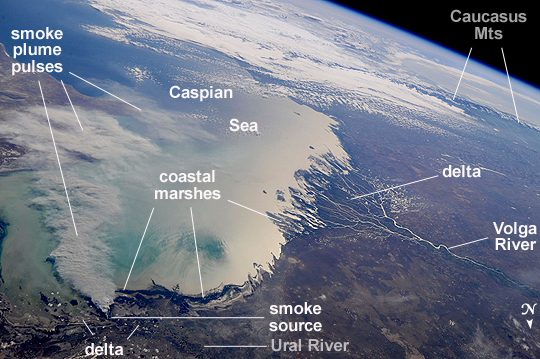
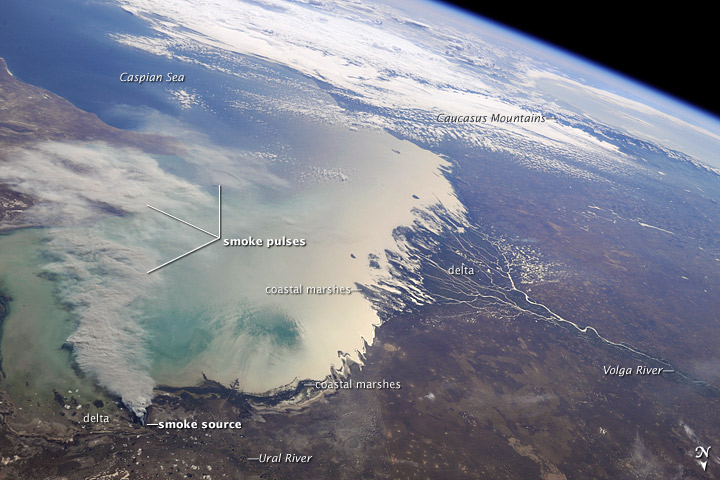
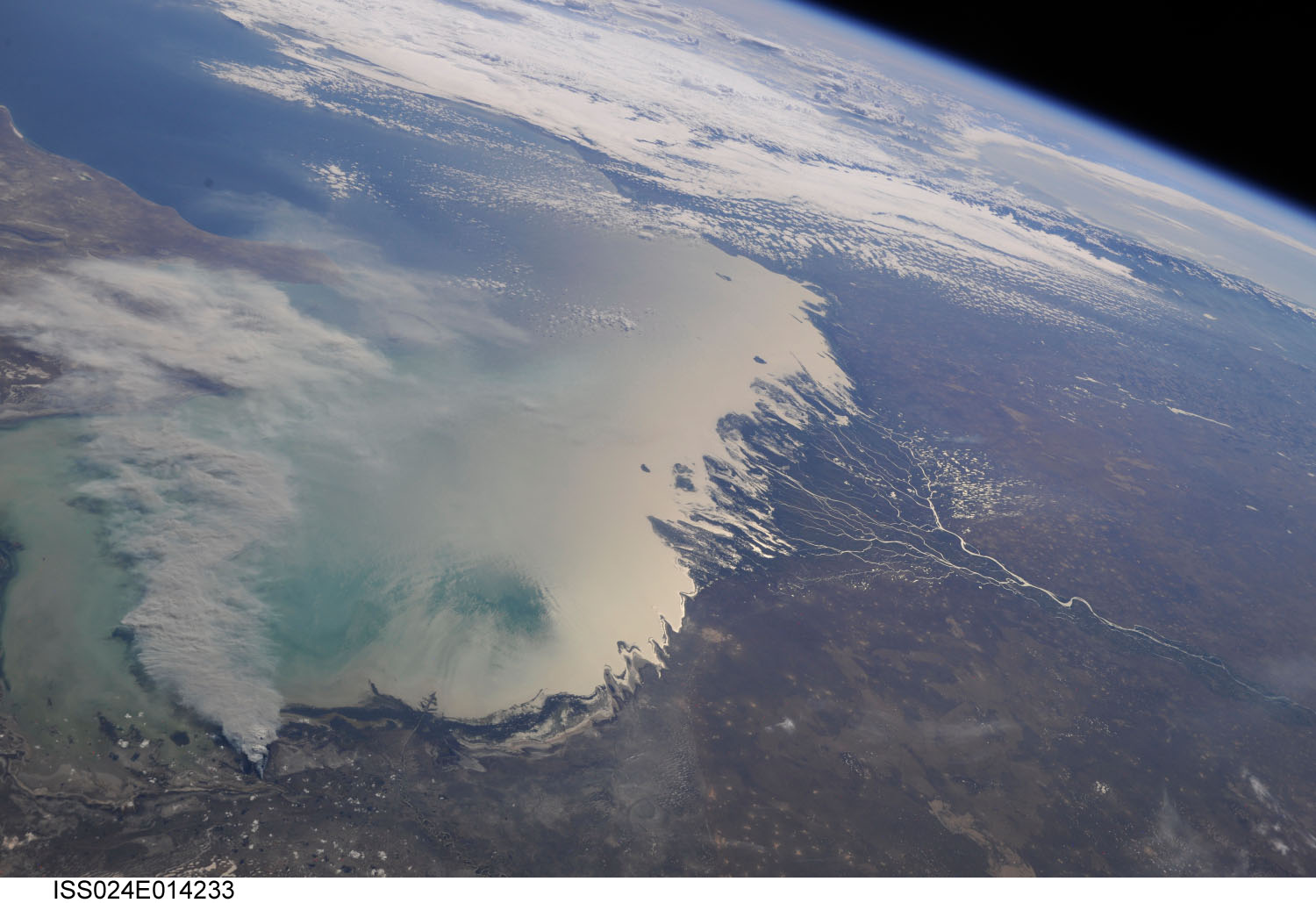
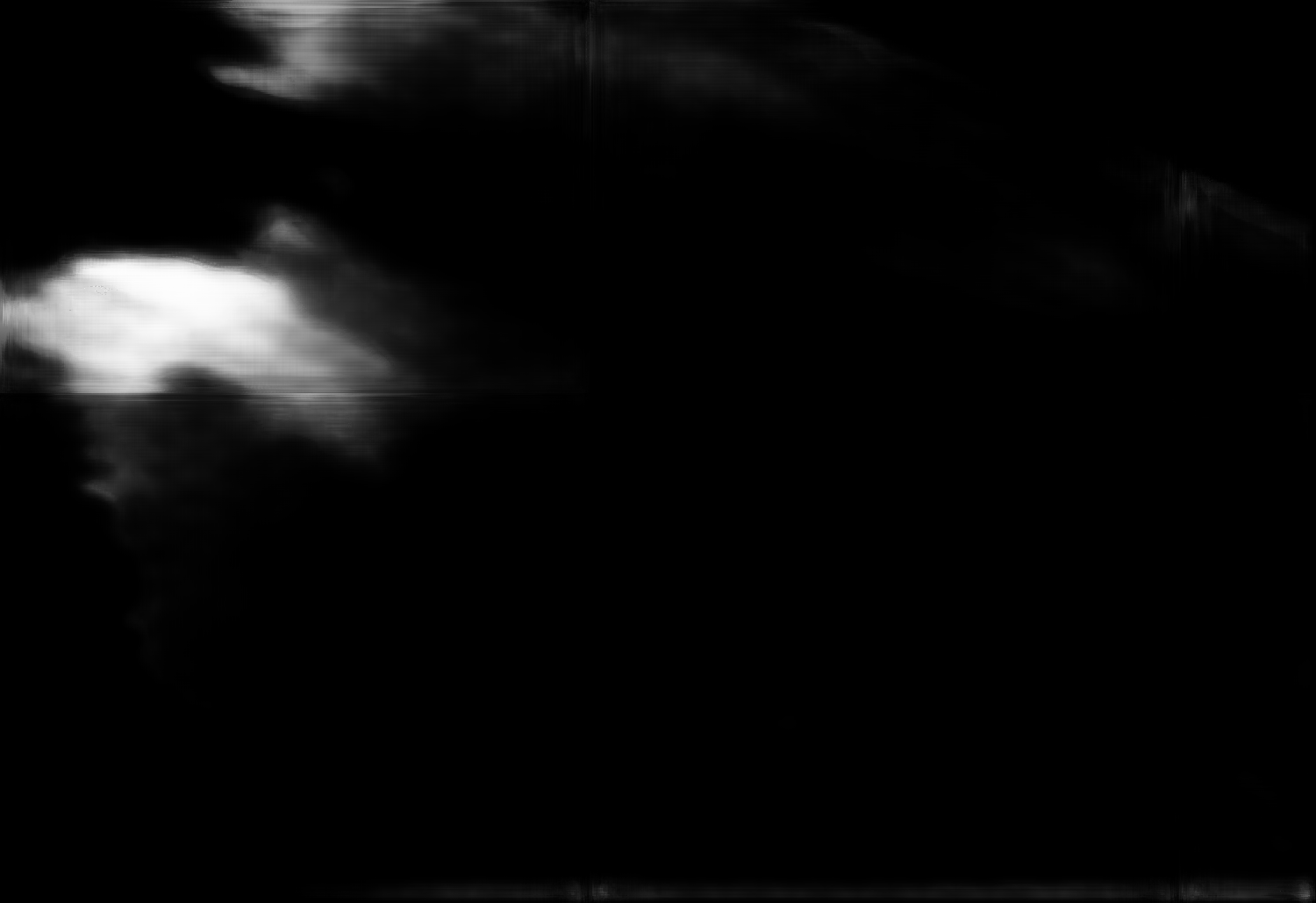
This broad view of the north coast of the Caspian Sea shows a smoke plume (image left) and two river deltas (image bottom and lower right). The larger delta is that of the Volga River which appears prominently here in sunglint (light reflected off a water surface back towards the observer), and the smaller less prominent delta is that of the Ural River. Wide angle, oblique views - taken looking outward at an angle, rather than straight down towards the Earth - such as this give an excellent impression of how astronauts onboard the International Space Station view the Earth. For a sense of scale, the Caucasus Mts. (across the Caspian , image top right) are approximately 1100 km to the southwest of the International Space Station's nadir point location - the point on the Earth directly underneath the spacecraft - at the time this image was taken.
The smoke plume appears to be sourced in the dark-toned coastal marsh vegetation along the outer fringe of the Ural River delta, rather than in a city or at some oil storage facility. Although even small fires produce plumes that are long and bright and thus easily visible from space, the density of the smoke in this plume, and its 350-km length across the entire north lobe of the Caspian Sea, suggest it was a significant fire. The smoke was thick enough nearer the source to cast shadows on the sea surface below. Lines mark three separate pulses of smoke, the most recent, nearest the source, extending directly south away from the coastline (image lower left). With time, plumes become progressively more diffuse. The oldest pulse appears to be the thinnest, casting no obvious shadows (image center left).
This broad view of the north coast of the Caspian Sea shows a smoke plume (image left) and two river deltas (image bottom and lower right). The larger delta is that of the Volga River which appears prominently here in sunglint (light reflected off a water surface back towards the observer), and the smaller less prominent delta is that of the Ural River. Wide angle, oblique views - taken looking outward at an angle, rather than straight down towards the Earth - such as this give an excellent impression of how astronauts onboard the International Space Station view the Earth. For a sense of scale, the Caucasus Mts. (across the Caspian , image top right) are approximately 1100 km to the southwest of the International Space Station's nadir point location - the point on the Earth directly underneath the spacecraft - at the time this image was taken.
The smoke plume appears to be sourced in the dark-toned coastal marsh vegetation along the outer fringe of the Ural River delta, rather than in a city or at some oil storage facility. Although even small fires produce plumes that are long and bright and thus easily visible from space, the density of the smoke in this plume, and its 350-km length across the entire north lobe of the Caspian Sea, suggest it was a significant fire. The smoke was thick enough nearer the source to cast shadows on the sea surface below. Lines mark three separate pulses of smoke, the most recent, nearest the source, extending directly south away from the coastline (image lower left). With time, plumes become progressively more diffuse. The oldest pulse appears to be the thinnest, casting no obvious shadows (image center left).