< STS040-151-126 >

| NASA Photo ID | STS040-151-126 |
| Focal Length | 90mm |
| Date taken | 1991.06.09 |
| Time taken | 15:15:38 GMT |

Cloud masks available for this image:
Spacecraft nadir point: 38.1° N, 105.5° W
Photo center point: 38.0° N, 106.0° W
Photo center point by machine learning:
Photo center point: 38.0° N, 106.0° W
Photo center point by machine learning:
Nadir to Photo Center: West
Spacecraft Altitude: 152 nautical miles (282km)
Country or Geographic Name: | USA-COLORADO |
Features: | VALLEY N. OF ALAMOSA |
| Features Found Using Machine Learning: | |
Cloud Cover Percentage: | 0 (no clouds present) |
Sun Elevation Angle: | 39° |
Sun Azimuth: | 90° |
Camera: | Linhof |
Focal Length: | 90mm |
Camera Tilt: | 11 degrees |
Format: | QX868: Kodak, natural color positive, Ektachrome QX868(5017 emulsion), ASA 64, thin base |
Film Exposure: | Normal |
| Additional Information | |
| Width | Height | Annotated | Cropped | Purpose | Links |
|---|---|---|---|---|---|
| 4030 pixels | 5136 pixels | No | No | Earth From Space collection | Download Image |
| 502 pixels | 640 pixels | No | No | Earth From Space collection | Download Image |
| 640 pixels | 480 pixels | No | No | ISD 1 | Download Image |
Download Packaged File
Download a Google Earth KML for this Image
View photo footprint information
No GeoTIFF is available for this photo.Image Caption: STS040-151-126 San Luis Valley, South-Central Colorado, U.S.A. June 1991
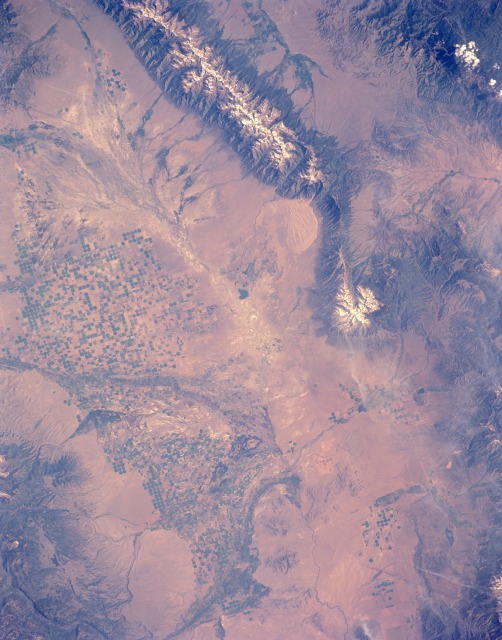
In semiarid San Luis Valley, relatively isolated in south-central Colorado between the Sangre de Cristo Mountains to the east and the San Juan Mountains to the west, farmers use center-pivot irrigation (indicated by circular patterns) in hundreds of fields. Most of the circular irrigated fields are less than a mile (kilometer) in diameter. A variety of crops, such as lettuce, alfalfa, field peas, oats, and potatoes, is grown in this remote valley. Pinto beans are a specialty of the area. Some cattle and sheep are also raised for local and distant markets. The farming community of Alamosa (not visible at this scale) is located slightly south of the center of the photograph where the Rio Grande makes its gradual turn southeast. The average elevation of the valley is 7500 feet (2300 meters) above sea level; several peaks in the Sangre de Cristo Mountains exceed 13 000 feet (3950 meters). The dendritic, highly reflective surfaces in the northern part of the valley show a well-developed, intermittent stream flow pattern. Although the headwaters of the Rio Grande are in the San Juan Mountains, the lack of vegetation (darker areas), except in cultivated fields, on some mountain slopes, and in some drainage features, confirms the general lack of moisture throughout this semiarid subregion of the Rocky Mountains. The Great Sand Dunes National Monument is visible (slightly northeast of photograph center) along the western flank of the Sangre de Cristo Mountains. The sands of these dunes have been blown from the valley floor by westerly winds in the course of the last few tens of thousands of years.
The Great Sand Dune National Monument, CO (38.0N, 126.0W) appears near the center of the image. The sands of these dunes, blown from the valley floor by westerly winds in the course of the past few tens of thousands of years, are now banked up against the foot of the 14,000 ft. Sangre de Christo Mountains. In the fields nearby, center pivot irrigation agriculture has almost entirely replaced the earlier rectangular grid pattern.
In semiarid San Luis Valley, relatively isolated in south-central Colorado between the Sangre de Cristo Mountains to the east and the San Juan Mountains to the west, farmers use center-pivot irrigation (indicated by circular patterns) in hundreds of fields. Most of the circular irrigated fields are less than a mile (kilometer) in diameter. A variety of crops, such as lettuce, alfalfa, field peas, oats, and potatoes, is grown in this remote valley. Pinto beans are a specialty of the area. Some cattle and sheep are also raised for local and distant markets. The farming community of Alamosa (not visible at this scale) is located slightly south of the center of the photograph where the Rio Grande makes its gradual turn southeast. The average elevation of the valley is 7500 feet (2300 meters) above sea level; several peaks in the Sangre de Cristo Mountains exceed 13 000 feet (3950 meters). The dendritic, highly reflective surfaces in the northern part of the valley show a well-developed, intermittent stream flow pattern. Although the headwaters of the Rio Grande are in the San Juan Mountains, the lack of vegetation (darker areas), except in cultivated fields, on some mountain slopes, and in some drainage features, confirms the general lack of moisture throughout this semiarid subregion of the Rocky Mountains. The Great Sand Dunes National Monument is visible (slightly northeast of photograph center) along the western flank of the Sangre de Cristo Mountains. The sands of these dunes have been blown from the valley floor by westerly winds in the course of the last few tens of thousands of years.
The Great Sand Dune National Monument, CO (38.0N, 126.0W) appears near the center of the image. The sands of these dunes, blown from the valley floor by westerly winds in the course of the past few tens of thousands of years, are now banked up against the foot of the 14,000 ft. Sangre de Christo Mountains. In the fields nearby, center pivot irrigation agriculture has almost entirely replaced the earlier rectangular grid pattern.