< STS040-614-58 >

| NASA Photo ID | STS040-614-58 |
| Focal Length | 250mm |
| Date taken | 1991.06.__ |
| Time taken | GMT |
Resolutions offered for this image:
3963 x 4008 pixels 632 x 639 pixels 5700 x 6000 pixels 500 x 526 pixels 640 x 480 pixels 3359 x 3318 pixels 439 x 438 pixels 439 x 438 pixels
3963 x 4008 pixels 632 x 639 pixels 5700 x 6000 pixels 500 x 526 pixels 640 x 480 pixels 3359 x 3318 pixels 439 x 438 pixels 439 x 438 pixels


Cloud masks available for this image:
Spacecraft nadir point:
Photo center point: 35.0° N, 111.0° W
Photo center point by machine learning:
Photo center point: 35.0° N, 111.0° W
Photo center point by machine learning:
Nadir to Photo Center:
Spacecraft Altitude: nautical miles (0km)
Country or Geographic Name: | USA-ARIZONA |
Features: | METEOR CRATER, WINSLOW |
| Features Found Using Machine Learning: | |
Cloud Cover Percentage: | 0 (no clouds present) |
Sun Elevation Angle: | ° |
Sun Azimuth: | ° |
Camera: | Rolleiflex |
Focal Length: | 250mm |
Camera Tilt: | Near Vertical |
Format: | 5017: Kodak, natural color positive, Ektachrome, X Professional, ASA 64, standard base |
Film Exposure: | Normal |
| Additional Information | |
| Width | Height | Annotated | Cropped | Purpose | Links |
|---|---|---|---|---|---|
| 3963 pixels | 4008 pixels | No | No | Earth From Space collection | Download Image |
| 632 pixels | 639 pixels | No | No | Earth From Space collection | Download Image |
| 5700 pixels | 6000 pixels | No | No | Download Image | |
| 500 pixels | 526 pixels | No | No | Download Image | |
| 640 pixels | 480 pixels | No | No | Download Image | |
| 3359 pixels | 3318 pixels | Download Image | |||
| 439 pixels | 438 pixels | Download Image | |||
| 439 pixels | 438 pixels | Download Image |
Download Packaged File
Download a Google Earth KML for this Image
View photo footprint information
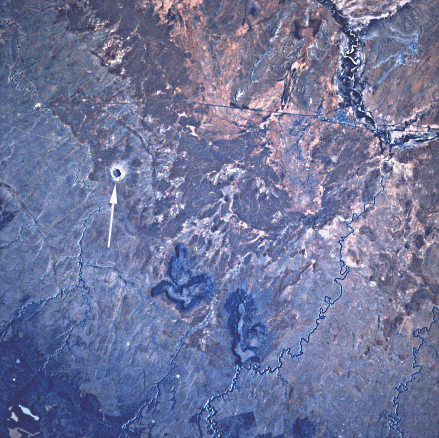
No GeoTIFF is available for this photo.Image Caption: STS040-614-058 Meteor Crater, Arizona, U.S.A. June 1991
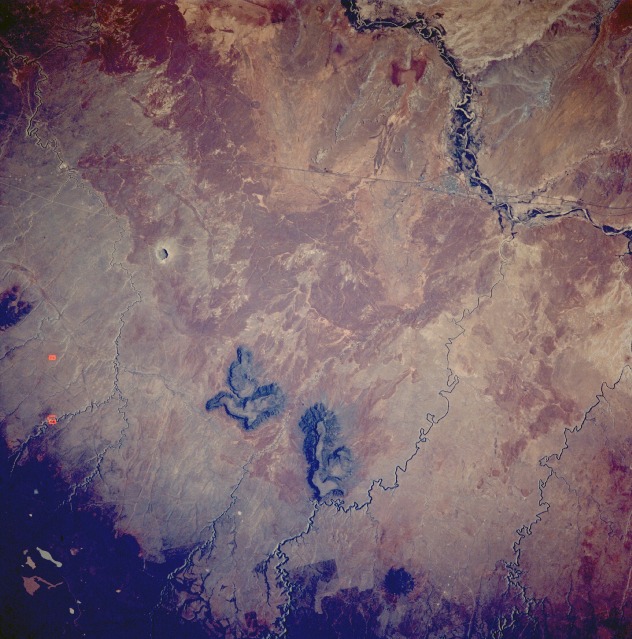
Meteor Crater is one of the best-known impact craters in the world. It can be seen just slightly west of the center of this near-vertical photograph. Although the crater is only 4000 feet (1200 meters) in diameter and nearly 600 feet (180 meters) deep, it is very conspicuous in this photograph because of the contrast between its bright rim--100-150 feet (30-46 meters) high--and the surrounding darker plain of sedimentary rock. The crater is believed to have been formed nearly 50 000 years ago. The dry riverbed of the Little Colorado River is visible east-northeast of the crater. The small city of Winslow, Arizona, is visible on the west bank of the river. Interstate Highway 40 can be seen north of Meteor Crater, running through Winslow. Two large buttes can be seen southeast of the crater. The butte farther from the center is Chevelon Butte, more than 6900 feet (2100 meters) high; it is situated between Clear Creek to its west and Chevelon Creek to its east. To the south of Meteor Crater and the buttes, the dark forested areas of the Mogollon Rim are visible.
Meteor Crater is one of the best-known impact craters in the world. It can be seen just slightly west of the center of this near-vertical photograph. Although the crater is only 4000 feet (1200 meters) in diameter and nearly 600 feet (180 meters) deep, it is very conspicuous in this photograph because of the contrast between its bright rim--100-150 feet (30-46 meters) high--and the surrounding darker plain of sedimentary rock. The crater is believed to have been formed nearly 50 000 years ago. The dry riverbed of the Little Colorado River is visible east-northeast of the crater. The small city of Winslow, Arizona, is visible on the west bank of the river. Interstate Highway 40 can be seen north of Meteor Crater, running through Winslow. Two large buttes can be seen southeast of the crater. The butte farther from the center is Chevelon Butte, more than 6900 feet (2100 meters) high; it is situated between Clear Creek to its west and Chevelon Creek to its east. To the south of Meteor Crater and the buttes, the dark forested areas of the Mogollon Rim are visible.