< STS095-726-51 >
| NASA Photo ID | STS095-726-51 |
| Focal Length | 250mm |
| Date taken | 1998.11.05 |
| Time taken | 12:34:25 GMT |
Cloud masks available for this image:
Spacecraft nadir point: 9.1° N, 43.9° E
Photo center point: 3.0° N, 46.5° E
Photo center point by machine learning:
Photo center point: 3.0° N, 46.5° E
Photo center point by machine learning:
Nadir to Photo Center: South
Spacecraft Altitude: 296 nautical miles (548km)
Camera: | Hasselblad |
Focal Length: | 250mm |
Camera Tilt: | 53 degrees |
Format: | 5069: Kodak Elite 100S, E6 Reversal, Replaces Lumiere, Warmer in tone vs. Lumiere |
Film Exposure: | Normal |
| Additional Information | |
| Width | Height | Annotated | Cropped | Purpose | Links |
|---|---|---|---|---|---|
| 5700 pixels | 5900 pixels | No | No | Download Image Download Color Calibration Image for this Image |
|
| 483 pixels | 500 pixels | No | No | Download Image Download Color Calibration Image for this Image |
Download Packaged File
Download a Google Earth KML for this Image
View photo footprint information
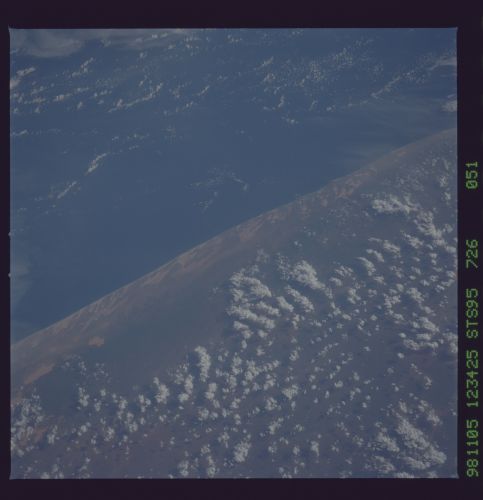
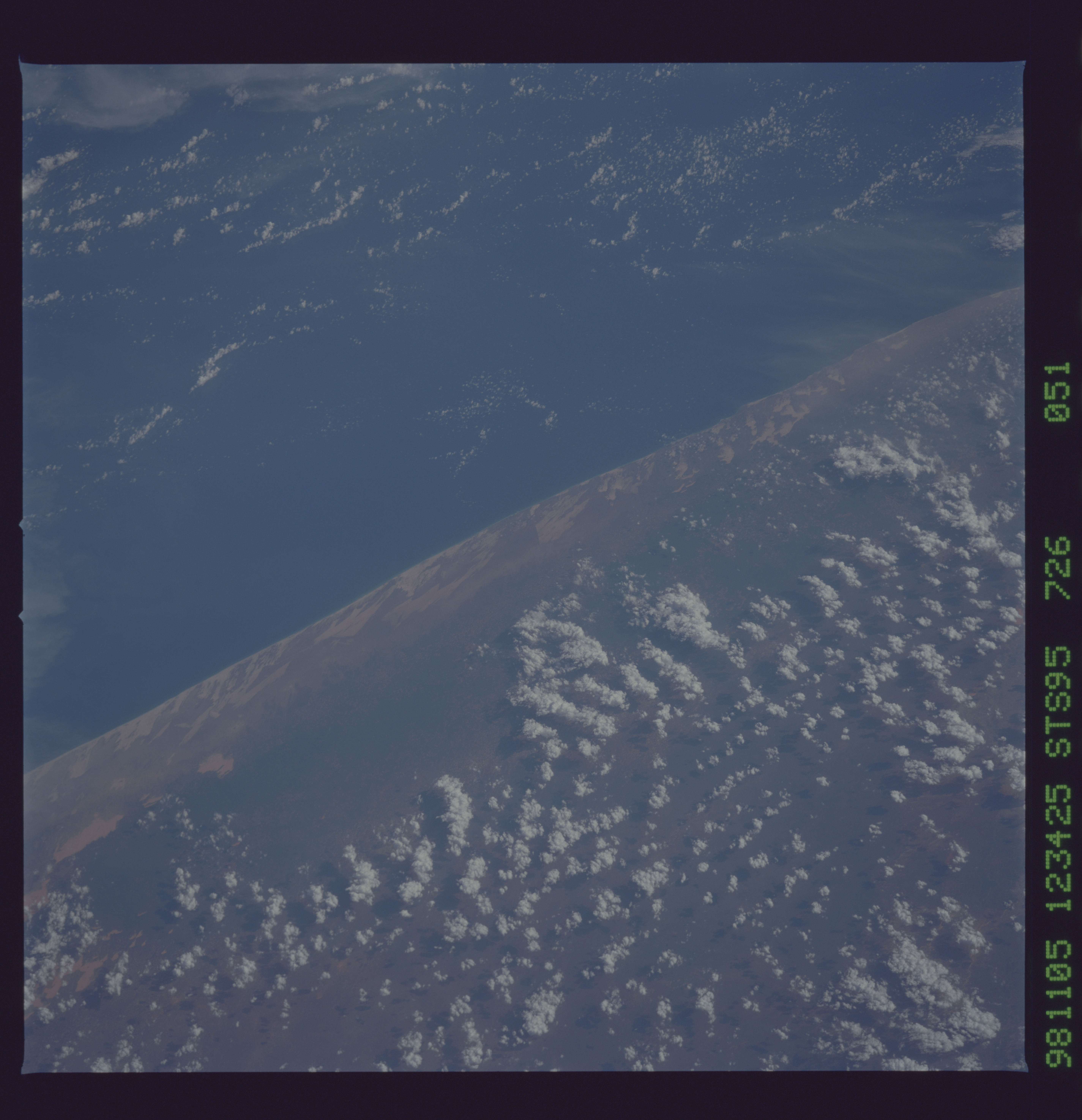
No GeoTIFF is available for this photo.Image Caption: Baraawee, Somalia and the Central Somalia coast, November 1998. Barraawe, Somalia is located among the coastal sand dunes south of Mogadishu. A cold episode or a moderate La Nina, was taking place in the Pacific when this photo was taken in Nov. 1998. Sea surface temperatures (SSTs) were cooler than average across the tropical Pacific from 160degE and 100degW, with equatorial SSTs more than 2degC below normal observed in several areas between the date line and 110degW during mid-November. The equatorial oceanic thermocline remained shallower than normal across the entire tropical Pacific during October, with subsurface temperatures as much as 5degC below average. The latest statistical and coupled model predictions indicate cold episode conditions continuing through May 1999.
Somalia had been in a dry period for 4 to 8 weeks, depending on location, when this photo was taken. At the time of this debrief, the Food and Agriculture Organization of the United Nations reported in their Nov. 98 Food Outlook newsletter that the food supply situation in Somalia is cause for serious concern as a result of a sharply drought-reduced 1998 main "Gu" crop, which followed the worst floods in decades. Also, the number of plantings and pest infestations helped reduce the "Gu" yield. In the next set of images of this area we expect the area to be more brown or orange in color due to the drier conditions.
Somalia had been in a dry period for 4 to 8 weeks, depending on location, when this photo was taken. At the time of this debrief, the Food and Agriculture Organization of the United Nations reported in their Nov. 98 Food Outlook newsletter that the food supply situation in Somalia is cause for serious concern as a result of a sharply drought-reduced 1998 main "Gu" crop, which followed the worst floods in decades. Also, the number of plantings and pest infestations helped reduce the "Gu" yield. In the next set of images of this area we expect the area to be more brown or orange in color due to the drier conditions.