< NASA7-726-49 >
| NASA Photo ID | NASA7-726-49 |
| Focal Length | mm |
| Date taken | 1998.05.29 |
| Time taken | GMT |

Cloud masks available for this image:
Spacecraft nadir point:
Photo center point:
Photo center point by machine learning:
Photo center point:
Photo center point by machine learning:
Nadir to Photo Center:
Spacecraft Altitude: nautical miles (0km)Body: Earth
Country or Geographic Name: | ATMOSPHERIC LIMB |
Features: | ATMOSPHERIC LIMB |
| Features Found Using Machine Learning: | |
Cloud Cover Percentage: | |
Sun Elevation Angle: | ° |
Sun Azimuth: | ° |
Camera: | Hasselblad |
Focal Length: | mm |
Camera Tilt: | High Oblique |
Format: | 5069: Kodak Elite 100S, E6 Reversal, Replaces Lumiere, Warmer in tone vs. Lumiere |
Film Exposure: | Normal |
| Additional Information | |
| Width | Height | Annotated | Cropped | Purpose | Links |
|---|---|---|---|---|---|
| 4400 pixels | 4600 pixels | No | No | Download Image | |
| 492 pixels | 515 pixels | No | No | Download Image |
Download Packaged File
Download a Google Earth KML for this Image
View photo footprint information
No GeoTIFF is available for this photo.Image Caption:
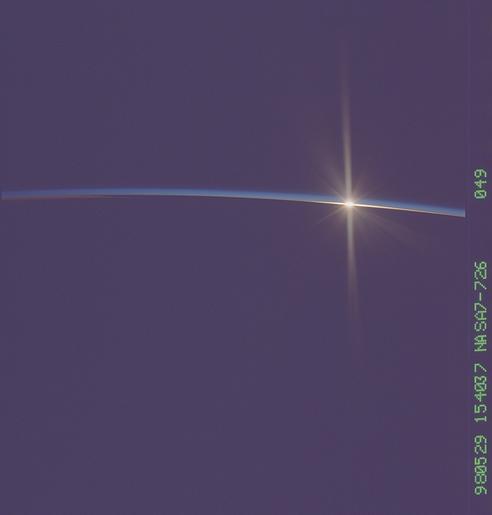
NASA7-726-49 Thin Blue Limb with Sunburst.This inspiring view of a sunrise was taken as the MIR was on a decending track toward Johnston Island, in the central Pacific (18.1N 176.6W). Sunrises and sunsets are seen by the astronauts and cosmonauts approximately every 45 min and differ in structure, since the tropopause altitude and atmospheric lamina temperatures vary with time of day, season, and latitude. From accounts by the astronauts true replication of human vision is not possible using present film. Some have said there are many more layers in the atmosphere than what the film is recording.
NASA7-726-49 Thin Blue Limb with Sunburst.This inspiring view of a sunrise was taken as the MIR was on a decending track toward Johnston Island, in the central Pacific (18.1N 176.6W). Sunrises and sunsets are seen by the astronauts and cosmonauts approximately every 45 min and differ in structure, since the tropopause altitude and atmospheric lamina temperatures vary with time of day, season, and latitude. From accounts by the astronauts true replication of human vision is not possible using present film. Some have said there are many more layers in the atmosphere than what the film is recording.