< ISS028-E-44433 >
| NASA Photo ID | ISS028-E-44433 |
| Focal Length | 180mm |
| Date taken | 2011.09.08 |
| Time taken | 09:59:21 GMT |
Resolutions offered for this image:
1000 x 720 pixels 540 x 389 pixels 720 x 480 pixels 4288 x 2848 pixels 640 x 425 pixels
1000 x 720 pixels 540 x 389 pixels 720 x 480 pixels 4288 x 2848 pixels 640 x 425 pixels



Spacecraft nadir point: 48.0° N, 83.9° E
Photo center point: 48.6° N, 82.0° E
Photo center point by machine learning:
Photo center point: 48.6° N, 82.0° E
Photo center point by machine learning:
Nadir to Photo Center: West
Spacecraft Altitude: 202 nautical miles (374km)
Country or Geographic Name: | KAZAKHSTAN |
Features: | BIGACH IMPACT CRATER, AGRICULTURAL FIELDS, YEGIN-BULAK |
| Features Found Using Machine Learning: | |
Cloud Cover Percentage: | 10 (1-10)% |
Sun Elevation Angle: | 28° |
Sun Azimuth: | 246° |
Camera: | Nikon D2Xs Electronic Still Camera |
Focal Length: | 180mm |
Camera Tilt: | 31 degrees |
Format: | 4288E: 4288 x 2848 pixel CMOS sensor, RGBG imager color filter |
Film Exposure: | |
| Additional Information | |
| Width | Height | Annotated | Cropped | Purpose | Links |
|---|---|---|---|---|---|
| 1000 pixels | 720 pixels | No | Yes | Earth From Space collection | Download Image |
| 540 pixels | 389 pixels | Yes | Yes | Earth From Space collection | Download Image |
| 720 pixels | 480 pixels | Yes | Yes | NASA's Earth Observatory web site | Download Image |
| 4288 pixels | 2848 pixels | No | No | Download Image | |
| 640 pixels | 425 pixels | No | No | Download Image |
Download Packaged File
Download a Google Earth KML for this Image
View photo footprint information
No GeoTIFF is available for this photo.Image Caption: Bigach Impact Crater, Kazakhstan
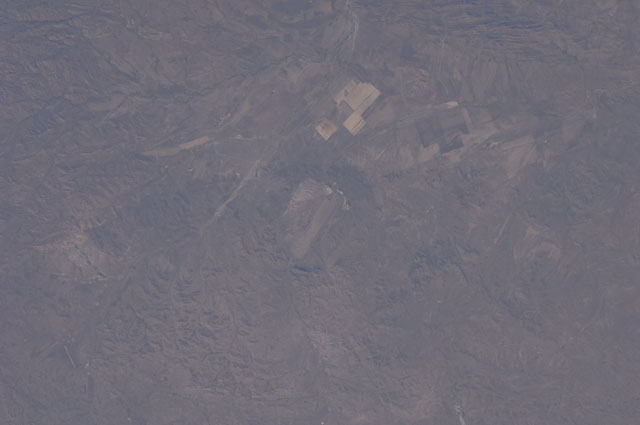
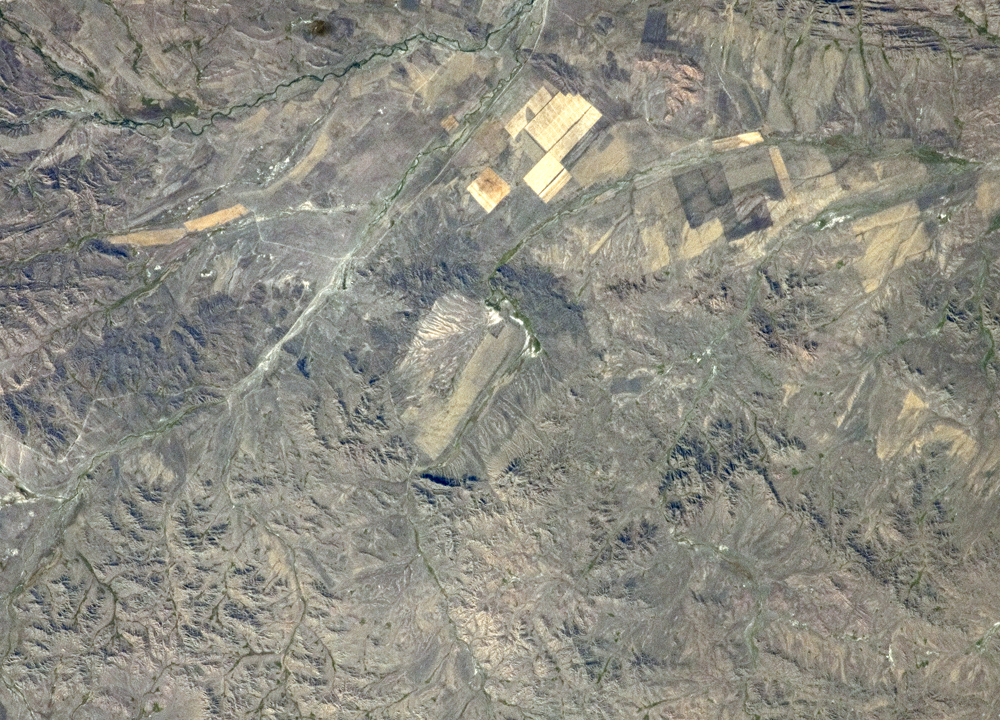
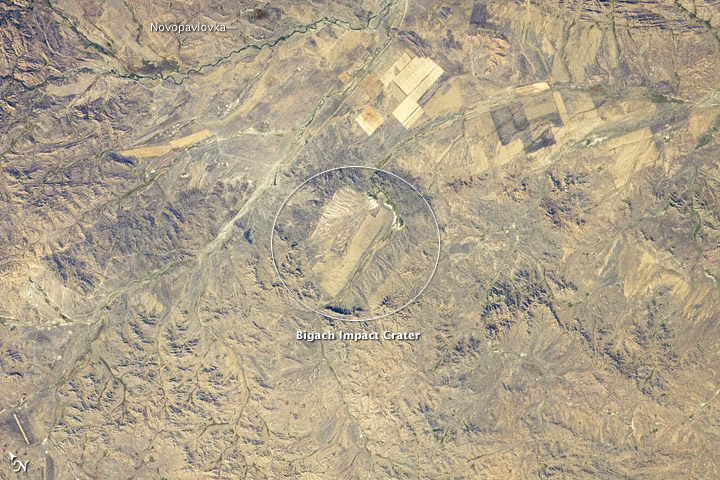
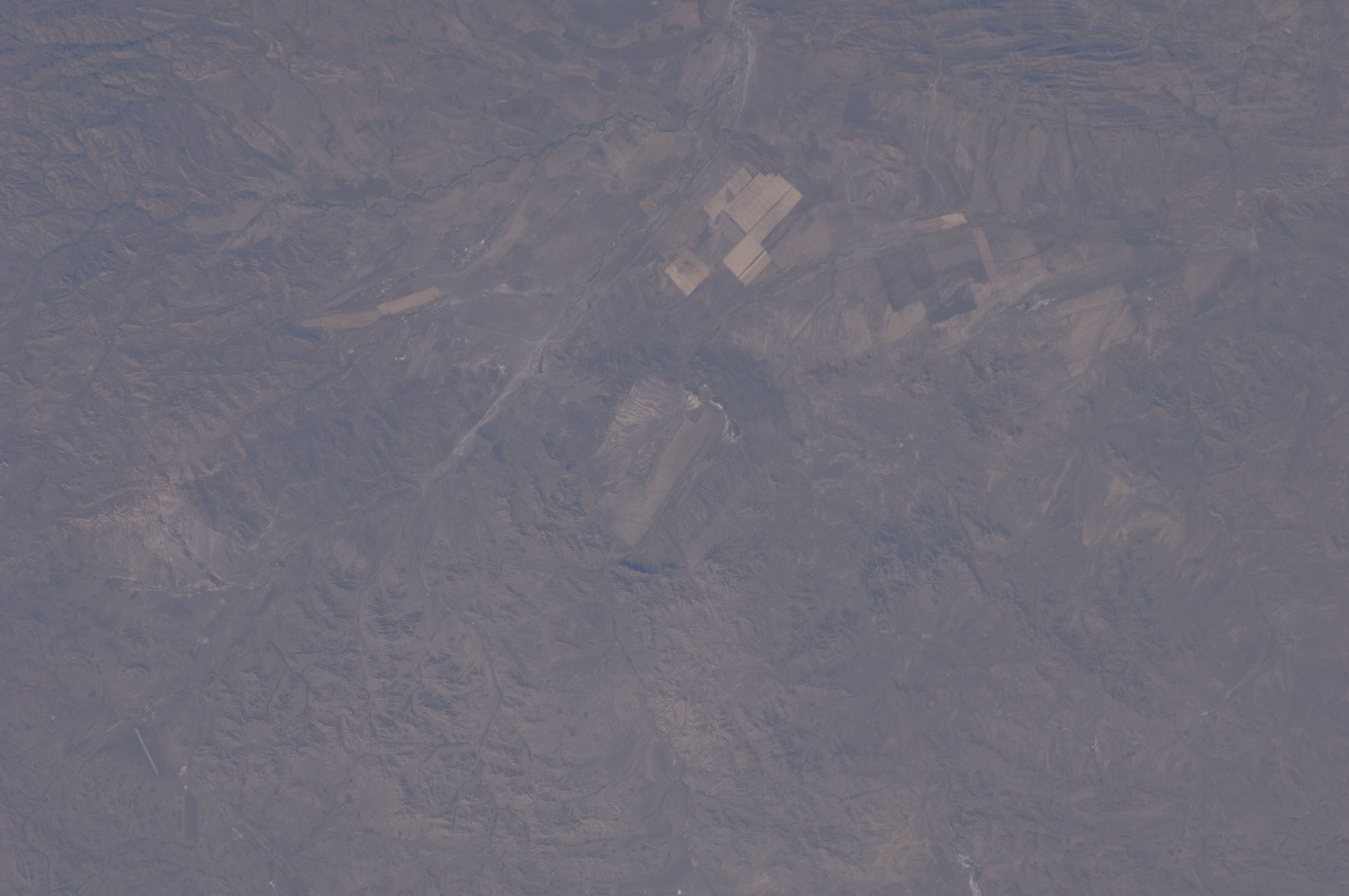
Some meteor impact craters, like Barringer Crater in Arizona, are easily recognizable on the landscape due to well-preserved form and features. Other impact structures, such as Bigach Impact Crater in northeastern Kazakhstan are harder to recognize due to their age, modification by subsequent geologic processes, or even human alteration of the landscape.
At approximately 5 million years old, Bigach is a relatively young geologic feature; however active tectonic processes in the region have caused movement of parts of the structure along faults, leading to a somewhat angular appearance (image center).
The roughly circular rim of the 8 km in diameter structure is still discernable around the relatively flat interior in this astronaut photograph. In addition to modification by faulting and erosion, the interior of the impact structure has also been used for agricultural activities, as indicated by the presence of tan regular graded fields. Other rectangular agricultural fields are visible to the northeast and east. The closest settlement, Novopavlovka, is barely visible near the top of the image.
Some meteor impact craters, like Barringer Crater in Arizona, are easily recognizable on the landscape due to well-preserved form and features. Other impact structures, such as Bigach Impact Crater in northeastern Kazakhstan are harder to recognize due to their age, modification by subsequent geologic processes, or even human alteration of the landscape.
At approximately 5 million years old, Bigach is a relatively young geologic feature; however active tectonic processes in the region have caused movement of parts of the structure along faults, leading to a somewhat angular appearance (image center).
The roughly circular rim of the 8 km in diameter structure is still discernable around the relatively flat interior in this astronaut photograph. In addition to modification by faulting and erosion, the interior of the impact structure has also been used for agricultural activities, as indicated by the presence of tan regular graded fields. Other rectangular agricultural fields are visible to the northeast and east. The closest settlement, Novopavlovka, is barely visible near the top of the image.