< STS027-39-44 >

| NASA Photo ID | STS027-39-44 |
| Focal Length | 250mm |
| Date taken | 1988.12.03 |
| Time taken | 03:06:40 GMT |

Cloud masks available for this image:
Spacecraft nadir point: 39.3° N, 100.3° E
Photo center point:
Photo center point by machine learning:
Photo center point:
Photo center point by machine learning:
Nadir to Photo Center:
Spacecraft Altitude: 240 nautical miles (444km)Body: Earth
Country or Geographic Name: | CHINA |
Features: | SAND DUNES, TSAIDAM BASIN |
| Features Found Using Machine Learning: | |
Cloud Cover Percentage: | 20 (11-25)% |
Sun Elevation Angle: | 22° |
Sun Azimuth: | 149° |
Camera: | Hasselblad |
Focal Length: | 250mm |
Camera Tilt: | Low Oblique |
Format: | 5017: Kodak, natural color positive, Ektachrome, X Professional, ASA 64, standard base |
Film Exposure: | Normal |
| Additional Information | |
| Width | Height | Annotated | Cropped | Purpose | Links |
|---|---|---|---|---|---|
| 5700 pixels | 5900 pixels | No | No | Download Image | |
| 500 pixels | 518 pixels | No | No | Download Image | |
| 640 pixels | 480 pixels | No | No | Download Image |
Download Packaged File
Download a Google Earth KML for this Image
View photo footprint information
No GeoTIFF is available for this photo.Image Caption:
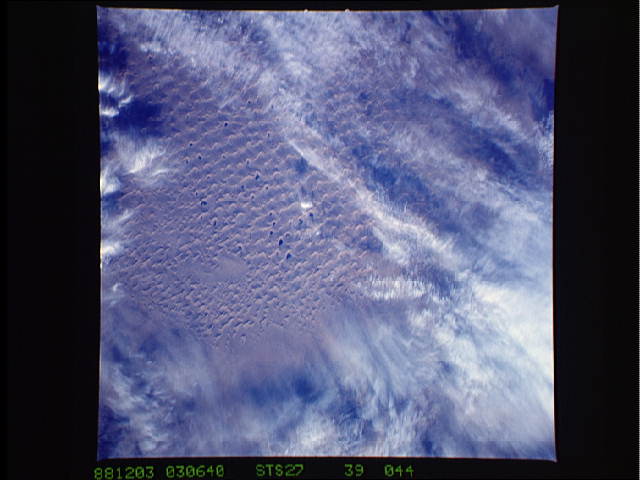
Detail of the Badain Jaran Dunes
The Gobi Desert is characterized by flat plains. Great areas are
underlain by glacial dust (loess) blown in from glaciated parts
of Asia in the recent geological past (the last 1-2 million
years). Smaller areas are covered by coarser material (sand),
and although sand is moved shorter distances, it is nevertheless
heaped up by sand-moving winds into organized lines of dunes, as
seen in this near-vertical view. Dune fields such as this usual-
ly occupy low topographic points into which rivers have drained
for millions of years. In such basins, water is sometimes near
the surface. In this photograph, brackish pools occupy hollows
between the lowest-lying dunes. Brackish water and an almost
complete lack of rainfall prevent the growth of vegetation.
(S27-39-44)
Detail of the Badain Jaran Dunes
The Gobi Desert is characterized by flat plains. Great areas are
underlain by glacial dust (loess) blown in from glaciated parts
of Asia in the recent geological past (the last 1-2 million
years). Smaller areas are covered by coarser material (sand),
and although sand is moved shorter distances, it is nevertheless
heaped up by sand-moving winds into organized lines of dunes, as
seen in this near-vertical view. Dune fields such as this usual-
ly occupy low topographic points into which rivers have drained
for millions of years. In such basins, water is sometimes near
the surface. In this photograph, brackish pools occupy hollows
between the lowest-lying dunes. Brackish water and an almost
complete lack of rainfall prevent the growth of vegetation.
(S27-39-44)