< STS081-720-23 >
| NASA Photo ID | STS081-720-23 |
| Focal Length | 100mm |
| Date taken | 1997.01.__ |
| Time taken | GMT |
Resolutions offered for this image:
4096 x 4096 pixels 640 x 640 pixels 5700 x 5900 pixels 483 x 500 pixels 656 x 647 pixels
4096 x 4096 pixels 640 x 640 pixels 5700 x 5900 pixels 483 x 500 pixels 656 x 647 pixels


Cloud masks available for this image:
Spacecraft nadir point:
Photo center point: 37.0° S, 143.0° E
Photo center point by machine learning:
Photo center point: 37.0° S, 143.0° E
Photo center point by machine learning:
Nadir to Photo Center:
Spacecraft Altitude: nautical miles (0km)
Country or Geographic Name: | AUSTRALIA-V |
Features: | COAST, LAKE CORANGAMITE, MIR |
| Features Found Using Machine Learning: | |
Cloud Cover Percentage: | 5 (1-10)% |
Sun Elevation Angle: | ° |
Sun Azimuth: | ° |
Camera: | Hasselblad |
Focal Length: | 100mm |
Camera Tilt: | |
Format: | 5046: Kodak, natural color positive, Lumiere 100/5046, ASA 100, standard base |
Film Exposure: | Normal |
| Additional Information | |
| Width | Height | Annotated | Cropped | Purpose | Links |
|---|---|---|---|---|---|
| 4096 pixels | 4096 pixels | No | No | Earth From Space collection | Download Image |
| 640 pixels | 640 pixels | No | No | Earth From Space collection | Download Image |
| 5700 pixels | 5900 pixels | No | No | Download Image Download Color Calibration Image for this Image |
|
| 483 pixels | 500 pixels | No | No | Download Image Download Color Calibration Image for this Image |
|
| 656 pixels | 647 pixels | No | No | Download Image |
Download Packaged File
Download a Google Earth KML for this Image
View photo footprint information
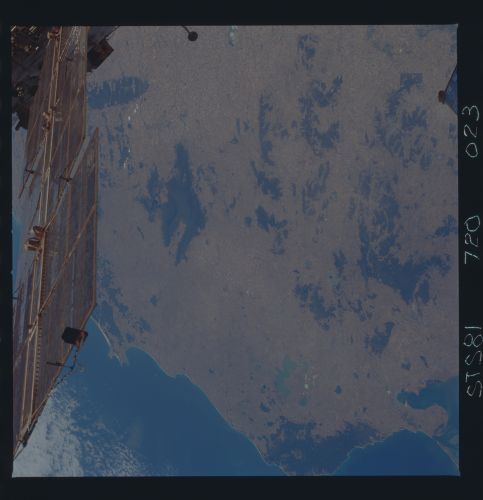
No GeoTIFF is available for this photo.Image Caption: STS081-720-023 Lake Corangamite, Victoria, Australia January 1997
The area included in this synoptic, westerly view of southwest Victoria shows vegetated hills and mountains (dark features), extensive plains (lighter-colored areas), and several lakes (lower left quadrant). The large lake is Lake Corangamite, the largest salt lake in Victoria and also the largest permanent inland lake in Australia. The Grampian range of mountains (larger dark region near center), dating back over 400 million years, provides a dramatic contrast to the flat plains that surround the Grampians. These sandstone mountains are characterized by lush vegetation, massive rock outcrops, and numerous, deep gorges. The Grampians represent the most west point of the Great Dividing Range of Australia. Most of this mountainous terrain is part of Grampian National Park. The object along the top of the image is an array of solar panels.
The area included in this synoptic, westerly view of southwest Victoria shows vegetated hills and mountains (dark features), extensive plains (lighter-colored areas), and several lakes (lower left quadrant). The large lake is Lake Corangamite, the largest salt lake in Victoria and also the largest permanent inland lake in Australia. The Grampian range of mountains (larger dark region near center), dating back over 400 million years, provides a dramatic contrast to the flat plains that surround the Grampians. These sandstone mountains are characterized by lush vegetation, massive rock outcrops, and numerous, deep gorges. The Grampians represent the most west point of the Great Dividing Range of Australia. Most of this mountainous terrain is part of Grampian National Park. The object along the top of the image is an array of solar panels.