< STS037-152-184 >
| NASA Photo ID | STS037-152-184 |
| Focal Length | 250mm |
| Date taken | 1991.04.07 |
| Time taken | 07:02:50 GMT |
Resolutions offered for this image:
5201 x 4056 pixels 640 x 499 pixels 640 x 480 pixels 1113 x 1413 pixels
5201 x 4056 pixels 640 x 499 pixels 640 x 480 pixels 1113 x 1413 pixels
Cloud masks available for this image:
Spacecraft nadir point: 25.4° N, 45.4° E
Photo center point: 29.3° N, 47.5° E
Photo center point by machine learning:
Photo center point: 29.3° N, 47.5° E
Photo center point by machine learning:
Nadir to Photo Center: Northeast
Spacecraft Altitude: 247 nautical miles (457km)
Country or Geographic Name: | KUWAIT |
Features: | KUWAIT OIL WELL FIRES |
| Features Found Using Machine Learning: | |
Cloud Cover Percentage: | 0 (no clouds present) |
Sun Elevation Angle: | 56° |
Sun Azimuth: | 118° |
Camera: | Linhof |
Focal Length: | 250mm |
Camera Tilt: | 47 degrees |
Format: | QX868: Kodak, natural color positive, Ektachrome QX868(5017 emulsion), ASA 64, thin base |
Film Exposure: | Normal |
| Additional Information | |
| Width | Height | Annotated | Cropped | Purpose | Links |
|---|---|---|---|---|---|
| 5201 pixels | 4056 pixels | Earth From Space collection | Download Image | ||
| 640 pixels | 499 pixels | Earth From Space collection | Download Image | ||
| 640 pixels | 480 pixels | No | No | ISD 1 | Download Image |
| 1113 pixels | 1413 pixels | No | No | Download Image |
Download Packaged File
Download a Google Earth KML for this Image
View photo footprint information
No GeoTIFF is available for this photo.Image Caption: STS037-152-184 Oil Well Fires, Kuwait April 1991
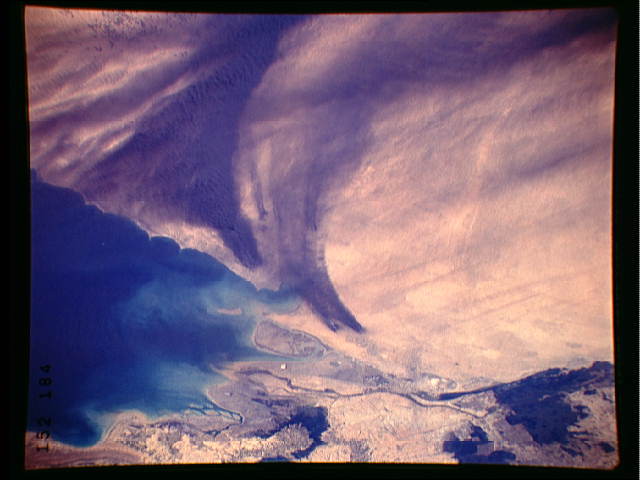
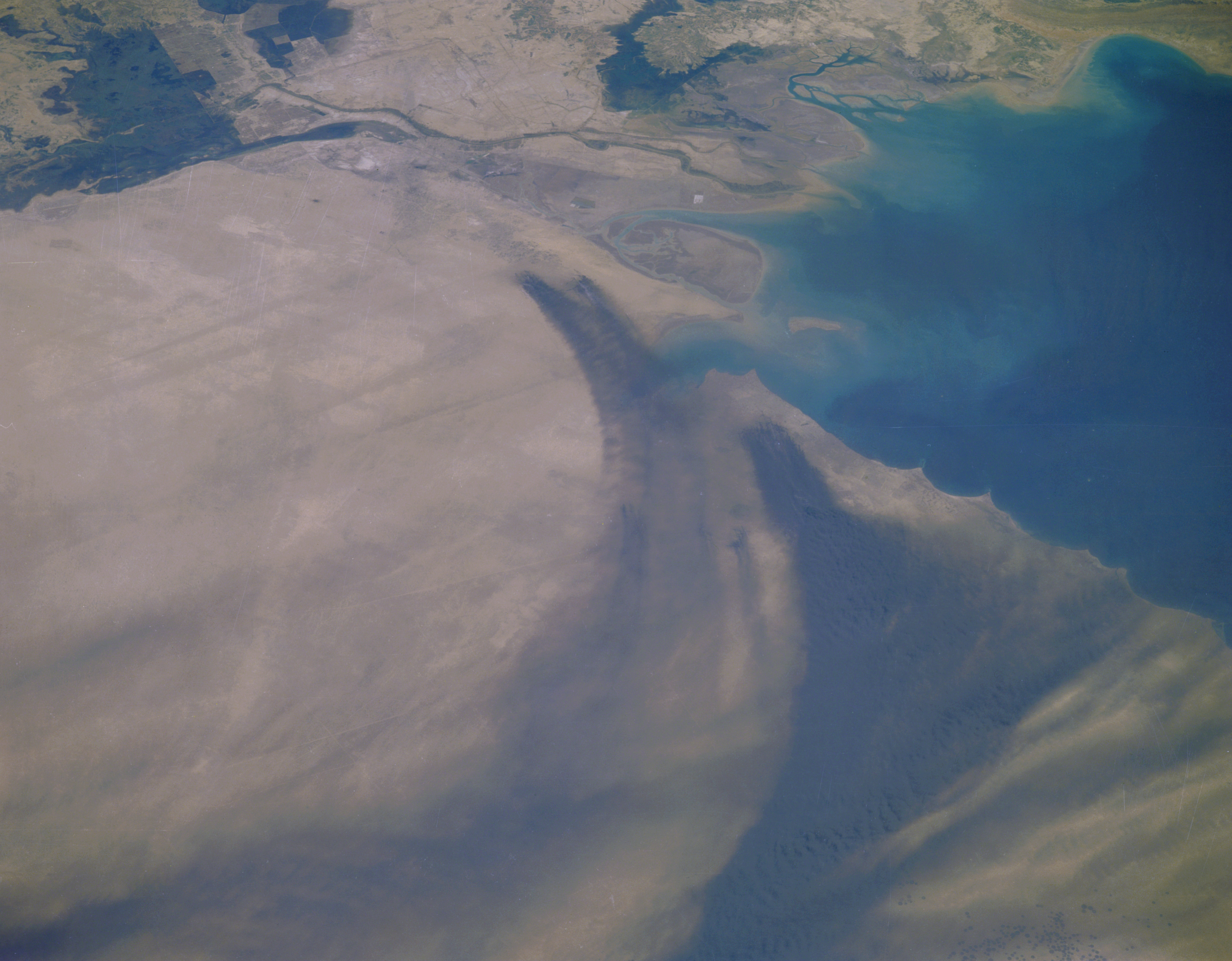
The Kuwait oil fields of Al Sabiriyah and Al Rawdatayn in the north (above center) and the Al Burqan in the south (right of center) can be seen burning and producing heavy black smoke plumes in this northeast-looking view. The image was obtained about four weeks after the end of the Gulf War. The Iraqi Government carried out their threat of a"scorched-earth"policy by systematically destroying nearly 80 percent of Kuwait's oil wells. The thick black smoke, traveling in a southwest direction near the surface, rose in altitude and was picked by the east-flowing sub-tropical jet stream between 16 000 feet (4 880 meters) to 25 000 feet (7 625 meters) and blown to the east and northeast out over the Persian Gulf (right). At the time of this image, work was just beginning to distinguish over 750 burning oil well fires. Thick marshes are still visible in the Tigris/Euphrates region.
Smoke from the burning oil fields to the north and south of Kuwait City, seen on the south shore of Kuwayt Bay almost totally obscures the view of the tiny, but oil rich, nation of Kuwait (29.5N, 47.5E). During the brief war between Iraq and the Allied forces, many of the oil wells in Kuwait were destroyed and set afire. For several months, those fires burned out of control, spewing wind borne smoke and ash for hundreds of miles.
The Kuwait oil fields of Al Sabiriyah and Al Rawdatayn in the north (above center) and the Al Burqan in the south (right of center) can be seen burning and producing heavy black smoke plumes in this northeast-looking view. The image was obtained about four weeks after the end of the Gulf War. The Iraqi Government carried out their threat of a"scorched-earth"policy by systematically destroying nearly 80 percent of Kuwait's oil wells. The thick black smoke, traveling in a southwest direction near the surface, rose in altitude and was picked by the east-flowing sub-tropical jet stream between 16 000 feet (4 880 meters) to 25 000 feet (7 625 meters) and blown to the east and northeast out over the Persian Gulf (right). At the time of this image, work was just beginning to distinguish over 750 burning oil well fires. Thick marshes are still visible in the Tigris/Euphrates region.
Smoke from the burning oil fields to the north and south of Kuwait City, seen on the south shore of Kuwayt Bay almost totally obscures the view of the tiny, but oil rich, nation of Kuwait (29.5N, 47.5E). During the brief war between Iraq and the Allied forces, many of the oil wells in Kuwait were destroyed and set afire. For several months, those fires burned out of control, spewing wind borne smoke and ash for hundreds of miles.