< ISS016-E-10894 >
| NASA Photo ID | ISS016-E-10894 |
| Focal Length | 180mm |
| Date taken | 2007.11.17 |
| Time taken | 15:33:24 GMT |
Resolutions offered for this image:
1000 x 700 pixels 540 x 378 pixels 540 x 405 pixels 3032 x 2064 pixels 639 x 435 pixels
1000 x 700 pixels 540 x 378 pixels 540 x 405 pixels 3032 x 2064 pixels 639 x 435 pixels



Spacecraft nadir point: 13.0° N, 87.5° W
Photo center point: 13.0° N, 87.4° W
Photo center point by machine learning:
Photo center point: 13.0° N, 87.4° W
Photo center point by machine learning:
Nadir to Photo Center: East
Spacecraft Altitude: 183 nautical miles (339km)
Country or Geographic Name: | NICARAGUA |
Features: | GULF OF FONSECA, SHRIMP FARMS |
| Features Found Using Machine Learning: | |
Cloud Cover Percentage: | 10 (1-10)% |
Sun Elevation Angle: | 46° |
Sun Azimuth: | 136° |
Camera: | Kodak DCS760c Electronic Still Camera |
Focal Length: | 180mm |
Camera Tilt: | 2 degrees |
Format: | 3060E: 3060 x 2036 pixel CCD, RGBG array |
Film Exposure: | |
| Additional Information | |
| Width | Height | Annotated | Cropped | Purpose | Links |
|---|---|---|---|---|---|
| 1000 pixels | 700 pixels | No | Yes | Earth From Space collection | Download Image |
| 540 pixels | 378 pixels | Yes | Yes | Earth From Space collection | Download Image |
| 540 pixels | 405 pixels | Yes | Yes | NASA's Earth Observatory web site | Download Image |
| 3032 pixels | 2064 pixels | No | No | Download Image | |
| 639 pixels | 435 pixels | No | No | Download Image |
Download Packaged File
Download a Google Earth KML for this Image
View photo footprint information
No GeoTIFF is available for this photo.Image Caption: Cosiguina Volcano, Nicaragua
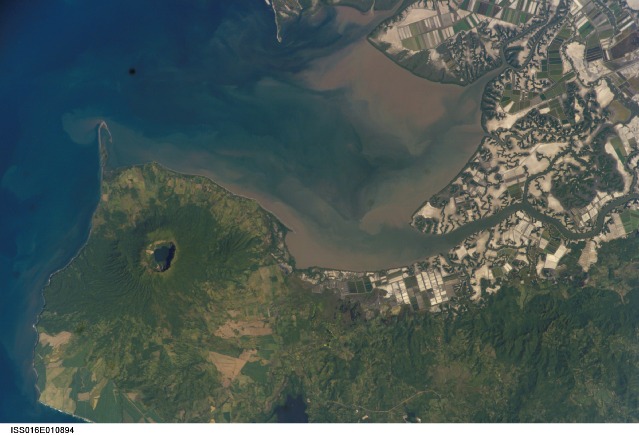
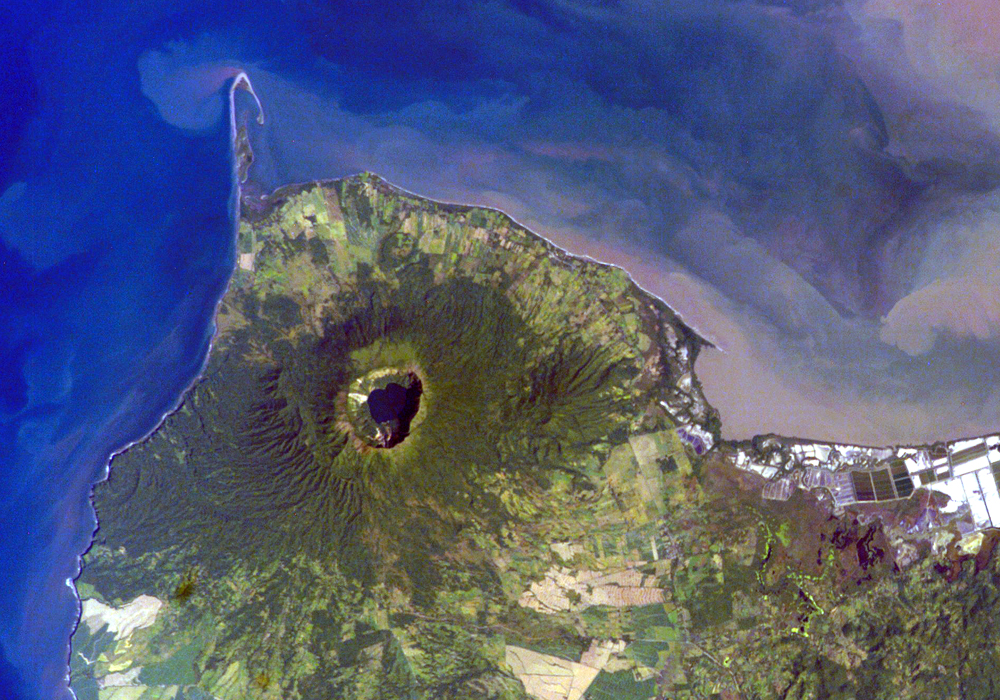
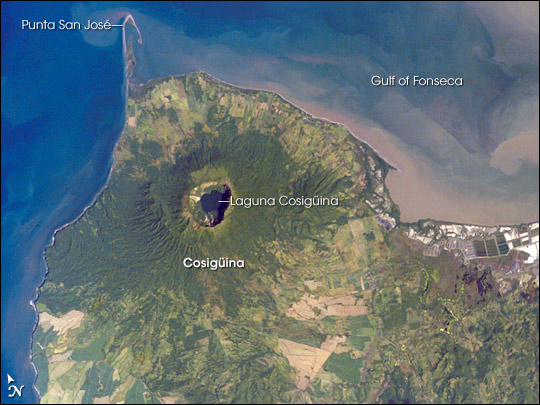
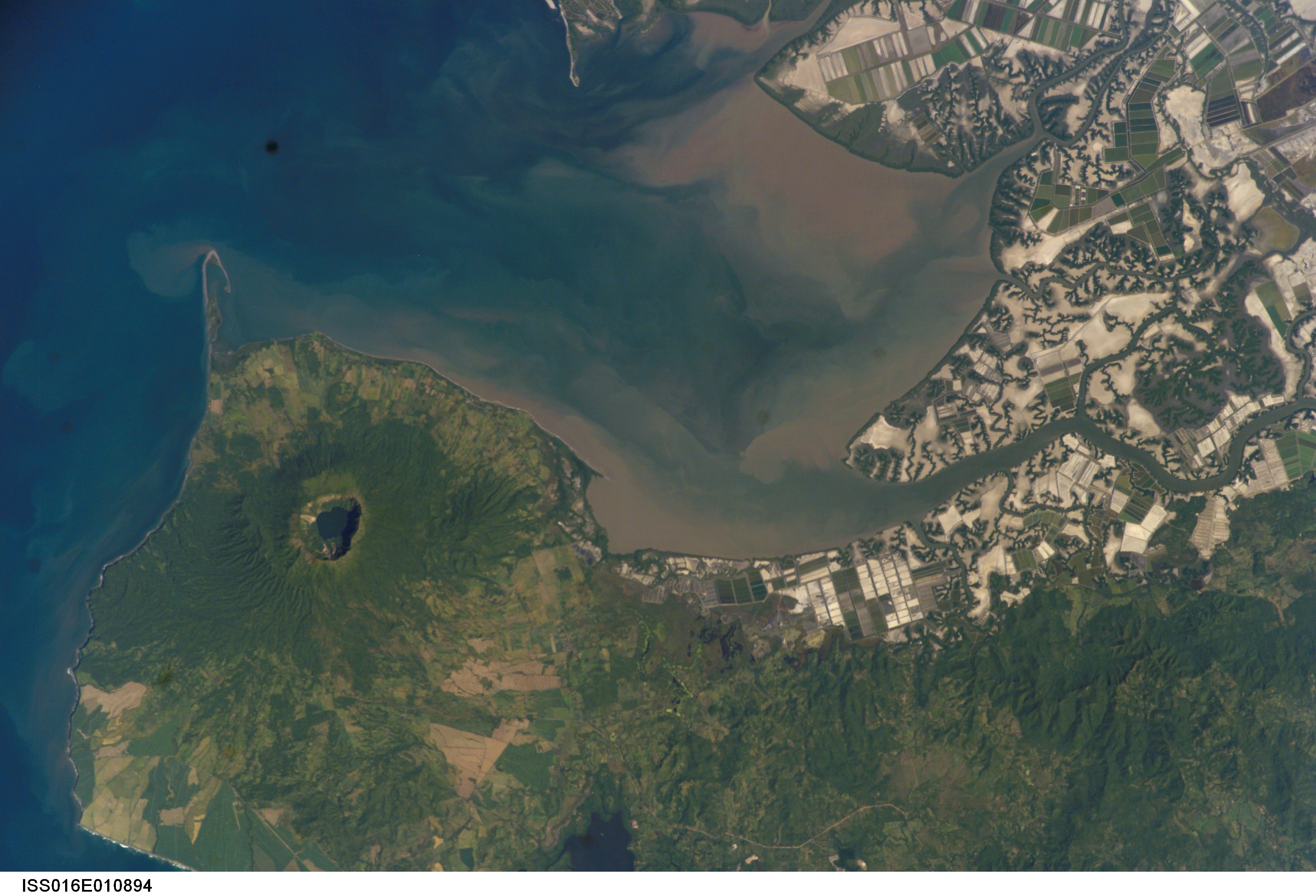
Three Central American countries--El Salvador, Honduras, and Nicaragua--have coastline along the Gulf of Fonseca, which opens into the Pacific Ocean. The southern boundary of the Gulf is a peninsula formed by the Cosiguina Volcano. Cosiguina is a stratovolcano, which is a cone-shaped volcano formed by alternating layers of solidified lava and volcanic rocks produced by explosive eruptions. The summit crater is filled with a lake (Laguna Cosiguina). The volcano last erupted in 1859, but its most famous activity occurred in 1835, when it produced the largest historical eruption in Nicaragua. Ash from the 1835 eruption has been found in Mexico, Costa Rica, and Jamaica.
The volcano has been quiet since 1859, only an instant in terms of geological time. An earthquake swarm was measured near Cosiguina in 2002, indicating that tectonic forces are still active in the region although the volcano is somewhat isolated from the line of more recently active Central American volcanoes to the northwest and southeast. The only indicators of hydrothermal activity at the volcano are intermittently observed gas bubbles in Laguna Cosiguina and a hot spring along the eastern flank of the volcano. The fairly uniform vegetation cover (green) on the volcano's sides also attest to a general lack of gas emissions or "hot spots" on the 872-meter-high cone.
Three Central American countries--El Salvador, Honduras, and Nicaragua--have coastline along the Gulf of Fonseca, which opens into the Pacific Ocean. The southern boundary of the Gulf is a peninsula formed by the Cosiguina Volcano. Cosiguina is a stratovolcano, which is a cone-shaped volcano formed by alternating layers of solidified lava and volcanic rocks produced by explosive eruptions. The summit crater is filled with a lake (Laguna Cosiguina). The volcano last erupted in 1859, but its most famous activity occurred in 1835, when it produced the largest historical eruption in Nicaragua. Ash from the 1835 eruption has been found in Mexico, Costa Rica, and Jamaica.
The volcano has been quiet since 1859, only an instant in terms of geological time. An earthquake swarm was measured near Cosiguina in 2002, indicating that tectonic forces are still active in the region although the volcano is somewhat isolated from the line of more recently active Central American volcanoes to the northwest and southeast. The only indicators of hydrothermal activity at the volcano are intermittently observed gas bubbles in Laguna Cosiguina and a hot spring along the eastern flank of the volcano. The fairly uniform vegetation cover (green) on the volcano's sides also attest to a general lack of gas emissions or "hot spots" on the 872-meter-high cone.