STS61A-50-20
| NASA Photo ID | STS61A-50-20 |
| Focal Length | 100mm |
| Date taken | 1985.10.31 |
| Time taken | 20:01:07 GMT |


Cloud masks available for this image:
Spacecraft nadir point: 42.3° S, 172.5° E
Photo center point: 43.0° S, 174.0° E
Photo center point by machine learning:
Photo center point: 43.0° S, 174.0° E
Photo center point by machine learning:
Nadir to Photo Center: East
Spacecraft Altitude: 181 nautical miles (335km)
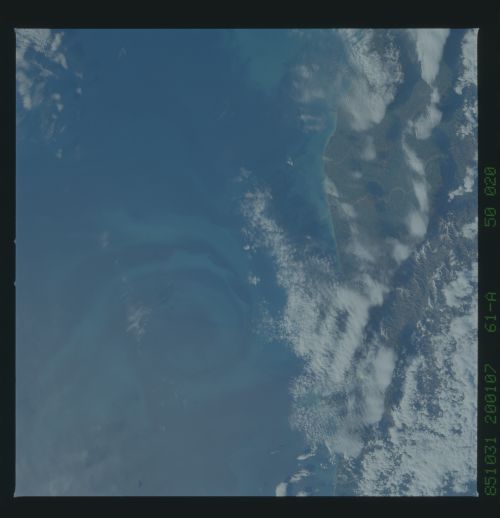
Country or Geographic Name: | NEW ZEALAND |
Features: | SO. IS., PLANKTON BLOOM |
| Features Found Using Machine Learning: | |
Cloud Cover Percentage: | 50 (26-50)% |
Sun Elevation Angle: | 29° |
Sun Azimuth: | 82° |
Camera: | Hasselblad |
Focal Length: | 100mm |
Camera Tilt: | 29 degrees |
Format: | 5017: Kodak, natural color positive, Ektachrome, X Professional, ASA 64, standard base |
Film Exposure: | Normal |
| Additional Information | |
| Width | Height | Annotated | Cropped | Purpose | Links |
|---|---|---|---|---|---|
| 5700 pixels | 5900 pixels | No | No | Download Image | |
| 500 pixels | 518 pixels | No | No | Download Image | |
| 640 pixels | 480 pixels | No | No | Download Image |
Download Packaged File
Download a Google Earth KML for this Image
View photo footprint information
Download a GeoTIFF for this photo
Image Caption: Plankton Bloom in Eddy off the New Zealand
coast.
This bright blue coccolithophor-type plankton bloom is
caught in a gyre off the East coast coast of New Zealand.
Notice the direction of the gyre (clockwise). This would be
a counter-clockwise motion in the Northern Hemisphere. We
have seen plankton blooms of different types occur in the
springtime (Oct-Nov) around New Zealand and Australia.
coast.
This bright blue coccolithophor-type plankton bloom is
caught in a gyre off the East coast coast of New Zealand.
Notice the direction of the gyre (clockwise). This would be
a counter-clockwise motion in the Northern Hemisphere. We
have seen plankton blooms of different types occur in the
springtime (Oct-Nov) around New Zealand and Australia.