Due to the lapse in federal government funding, NASA is not updating this website. We sincerely regret this inconvenience.

< SL2-X6-478 >

Browse image
Resolutions offered for this image:
3792 x 3792 pixels 4400 x 4600 pixels 4400 x 4600 pixels 478 x 500 pixels
Cloud masks available for this image:

Spacecraft nadir point:

Photo center point: 41.0° N, 113.0° W

Photo center point by machine learning:

Nadir to Photo Center:

Spacecraft Altitude: nautical miles (0km)
Click for a map
Width Height Annotated Cropped Purpose Links
3792 pixels 3792 pixels No No NASA's Earth Observatory web site Download Image
4400 pixels 4600 pixels No No Download Image
4400 pixels 4600 pixels No No Original file from film scan Download Image
478 pixels 500 pixels No No Download Image
Other options available:
Download Packaged File
Download a Google Earth KML for this Image
View photo footprint information
No GeoTIFF is available for this photo.
Image Caption:

The goal of the Skylab mission was to prove that humans could live and work in space for extended periods of time. But like every other human venture into the skies, somehow the view always turns back to Earth.

The first American space station was launched into orbit on a Saturn V rocket on May 14, 1973. In the nine months that followed, three separate crews made progressively longer stays on Skylab. The astronauts made observations of the Sun, including the first images of solar flares from space, conducted biomedical and microgravity experiments on themselves, and did a lot of maintenance and handy work to keep the converted rocket shell working as a laboratory. They also took photographs and observations of home.

"Between 8 and 10 at night, we had free time," said astronaut Gerald Carr, who commanded the third crewed mission on Skylab for 84 days. "For the most part, the most fun was looking out the window."

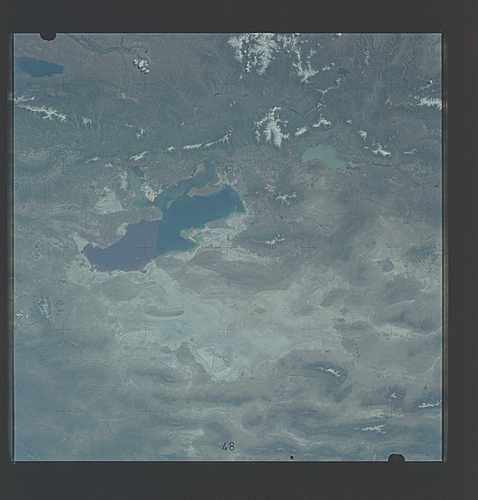
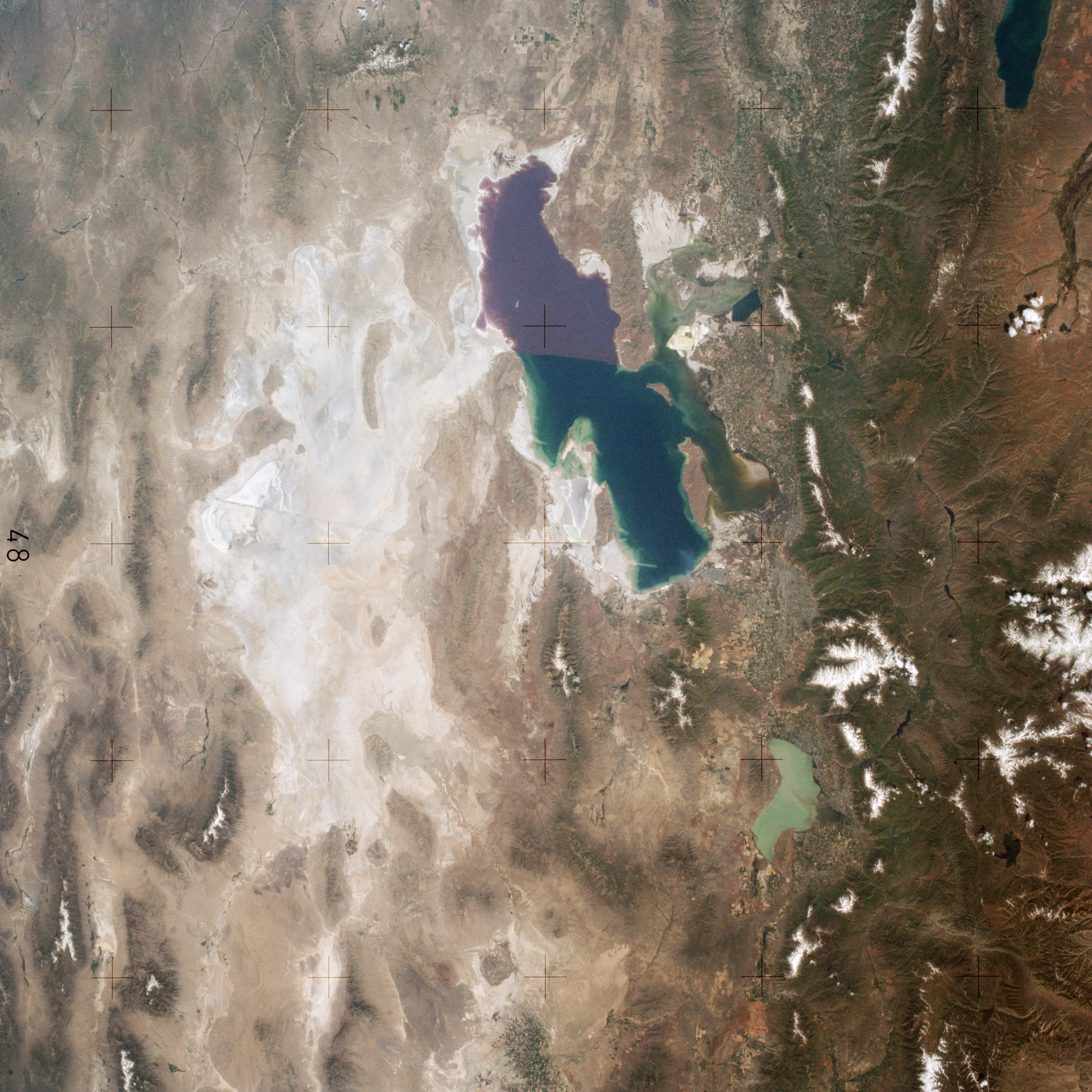
Astronauts on the Skylab 2 mission (May 25 to June 22, 1973) took this photograph of north central Utah with a Hasselblad camera, using an 80 millimeter lens and Kodak Etkachrome MS film. Note the different colors in the north and south sections of the Great Salt Lake, which are separated by a railroad causeway that restricts the mixing of the waters. The north section is much more salty, and different species of algae give the two sections different hues.

Skylab included several handheld cameras and the Earth Resources Experiment Package (EREP), a series of sensors and cameras that observed the Earth in visible, microwave, and infrared light. In 171 days of Skylab operation, EREP collected more than 350,000 photos and 72,725 meters (238,599 feet) of magnetic data tape, observing Earth's surface between roughly 50 degrees north and south latitude. The astronauts even observed category 5 Hurricane Ava near Acapulco, Mexico.