< ISS005-E-20451 >
| NASA Photo ID | ISS005-E-20451 |
| Focal Length | 800mm |
| Date taken | 2002.11.11 |
| Time taken | 08:26:00 GMT |
Resolutions offered for this image:
352 x 540 pixels 501 x 768 pixels 540 x 540 pixels 1000 x 1504 pixels 3032 x 2064 pixels 639 x 435 pixels
352 x 540 pixels 501 x 768 pixels 540 x 540 pixels 1000 x 1504 pixels 3032 x 2064 pixels 639 x 435 pixels


Spacecraft nadir point: 20.0° N, 20.6° E
Photo center point: 20.0° N, 18.5° E
Photo center point by machine learning:
Photo center point: 20.0° N, 18.5° E
Photo center point by machine learning:
Nadir to Photo Center: West
Spacecraft Altitude: 206 nautical miles (382km)
Country or Geographic Name: | CHAD |
Features: | EMI KOUSSI, CRATER DETAIL |
| Features Found Using Machine Learning: | |
Cloud Cover Percentage: | 0 (no clouds present) |
Sun Elevation Angle: | 43° |
Sun Azimuth: | 141° |
Camera: | Kodak DCS760c Electronic Still Camera |
Focal Length: | 800mm |
Camera Tilt: | 31 degrees |
Format: | 3060E: 3060 x 2036 pixel CCD, RGBG array |
Film Exposure: | |
| Additional Information | |
| Width | Height | Annotated | Cropped | Purpose | Links |
|---|---|---|---|---|---|
| 352 pixels | 540 pixels | Photographic Highlights | Download Image | ||
| 501 pixels | 768 pixels | Photographic Highlights | Download Image | ||
| 540 pixels | 540 pixels | Yes | Yes | Earth From Space collection | Download Image |
| 1000 pixels | 1504 pixels | No | No | NASA's Earth Observatory web site | Download Image |
| 3032 pixels | 2064 pixels | No | No | Download Image | |
| 639 pixels | 435 pixels | No | No | Download Image |
Download Packaged File
Download a Google Earth KML for this Image
View photo footprint information
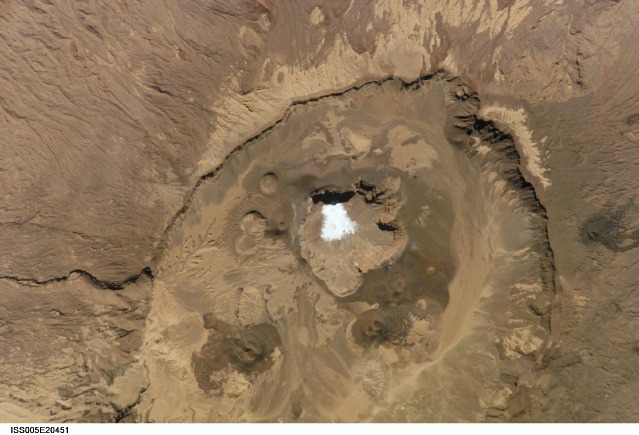
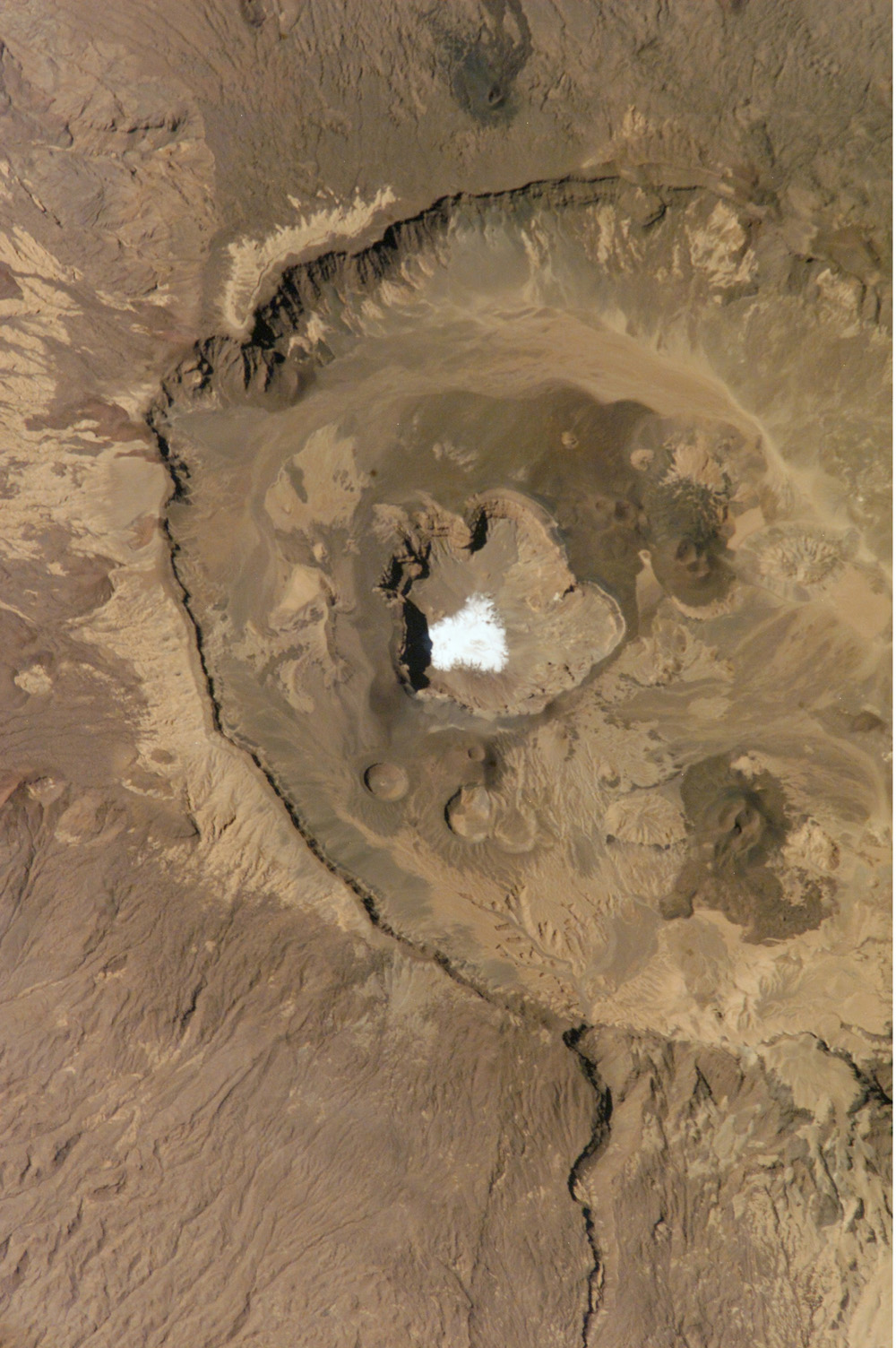
No GeoTIFF is available for this photo.Image Caption: Emi Koussi is a high volcano that lies at the south end of the Tibesti Mountains in the central Sahara in northern Chad. The volcano is one of several in the Tibesti massif, and reaches 3415 m in altitude, rising 2.3 km above the surrounding sandstone plains. The volcano is 65 km wide.
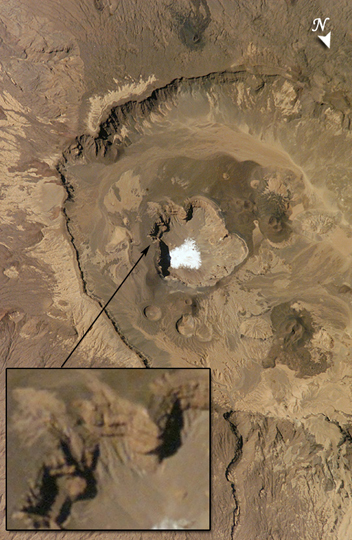
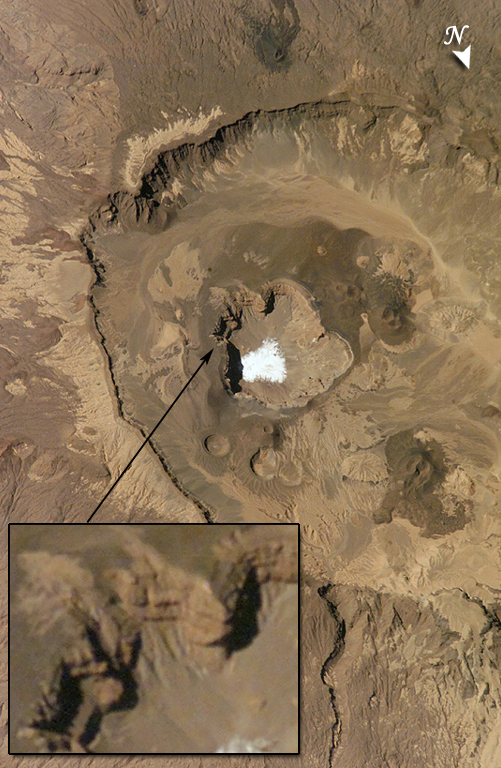
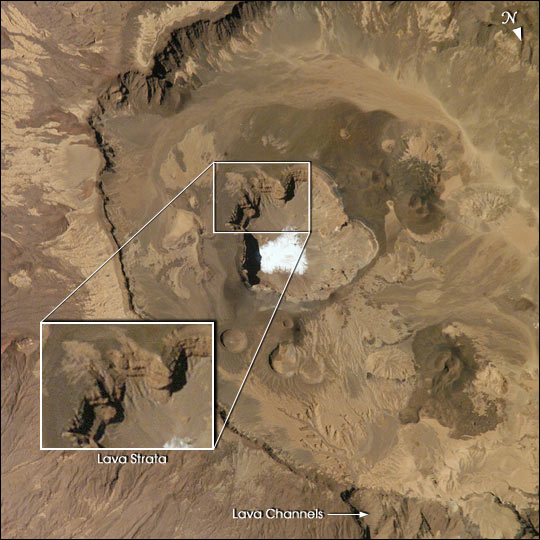
This view of the Emi Koussi caldera was taken with an 800 mm lens on November 11, 2002. It is detailed to the point that it doesn't include the entire 10-km diameter of the caldera, but reveals individual lava strata within the walls of the summit cliffs. Nested within the main caldera is a smaller crater that contains white salts of a dry lake at its lowest point. Here too, strata are visible in the walls of the smaller crater. The smaller crater is surrounded by a region of darker rocks--a geologically young dome of lava studded with several small circular volcanic vents.
Emi Koussi has been used as a close analog to the famous Martian volcano Elysium Mons (//www.msss.com/mars_images/moc/7_10_98_elysium_rel/). One of the most important morphological differences between volcanoes on Mars and Earth is the widespread furrowing of the surface due to flowing water on terrestrial volcanoes. The furrows are shallow valleys. Larger channels have a different origin. Major channels can be seen on volcanoes on both planets and indicate low points in caldera rims where lava spilled out of pre-collapse craters.
This view of the Emi Koussi caldera was taken with an 800 mm lens on November 11, 2002. It is detailed to the point that it doesn't include the entire 10-km diameter of the caldera, but reveals individual lava strata within the walls of the summit cliffs. Nested within the main caldera is a smaller crater that contains white salts of a dry lake at its lowest point. Here too, strata are visible in the walls of the smaller crater. The smaller crater is surrounded by a region of darker rocks--a geologically young dome of lava studded with several small circular volcanic vents.
Emi Koussi has been used as a close analog to the famous Martian volcano Elysium Mons (//www.msss.com/mars_images/moc/7_10_98_elysium_rel/). One of the most important morphological differences between volcanoes on Mars and Earth is the widespread furrowing of the surface due to flowing water on terrestrial volcanoes. The furrows are shallow valleys. Larger channels have a different origin. Major channels can be seen on volcanoes on both planets and indicate low points in caldera rims where lava spilled out of pre-collapse craters.